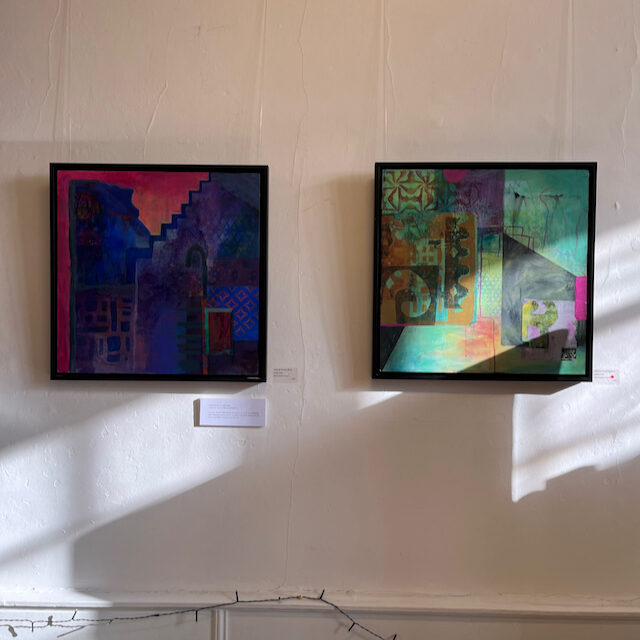
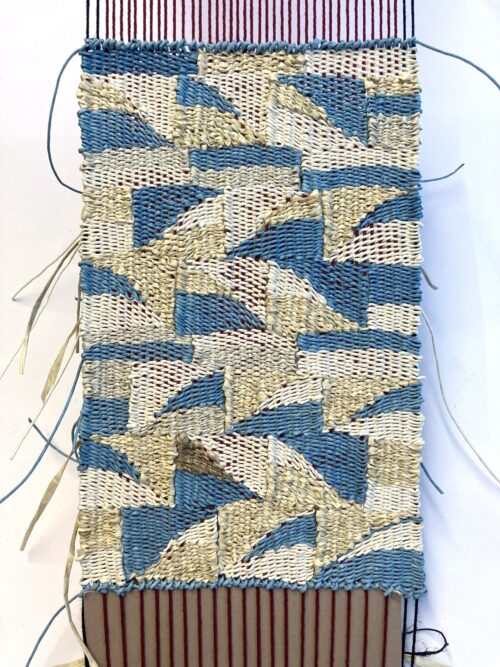
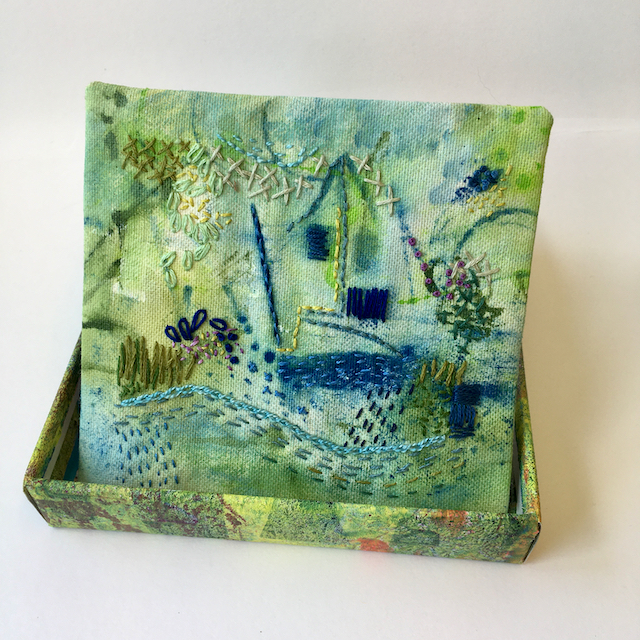
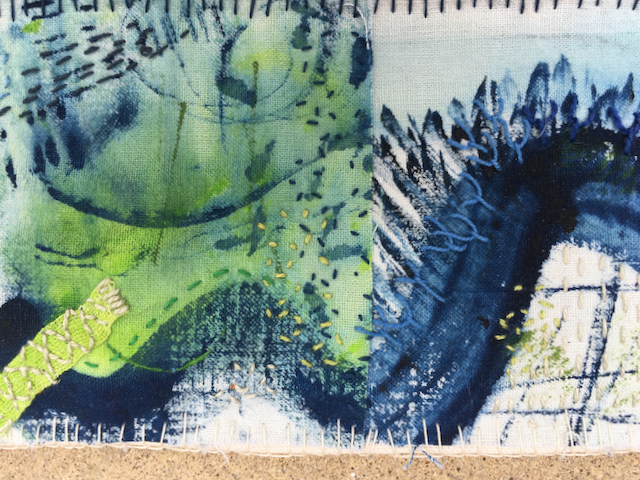
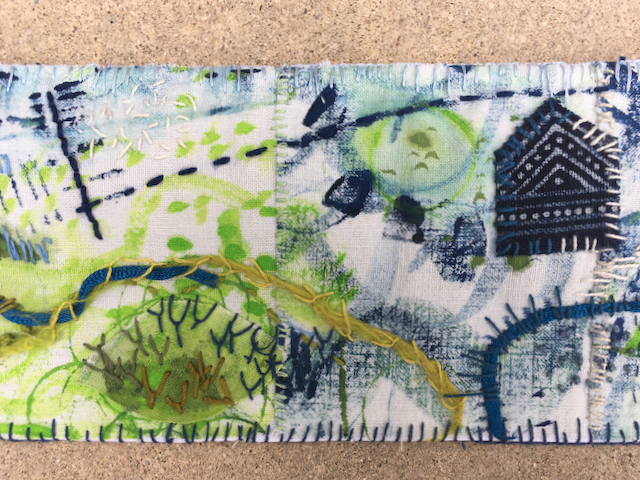
I’m looking forward to exhibiting at Eype Centre for the Arts for the first time with Artists of the Jurassic Coast. I shall be showing woven tapestries and mixed media (collaged paintings)
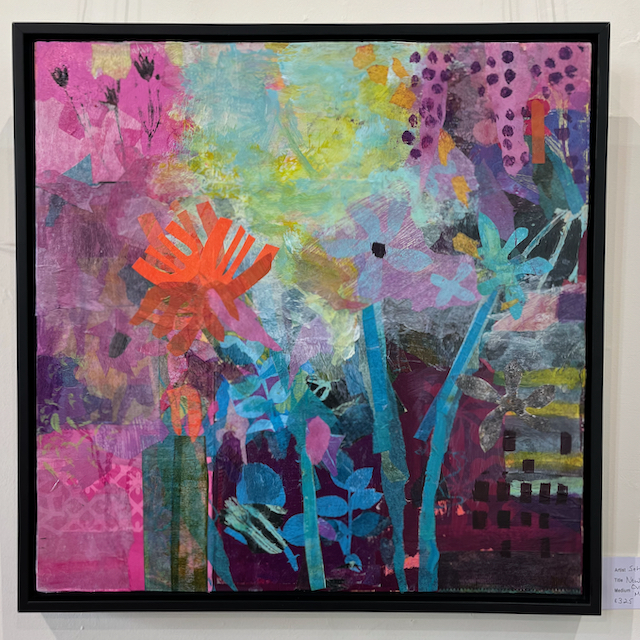
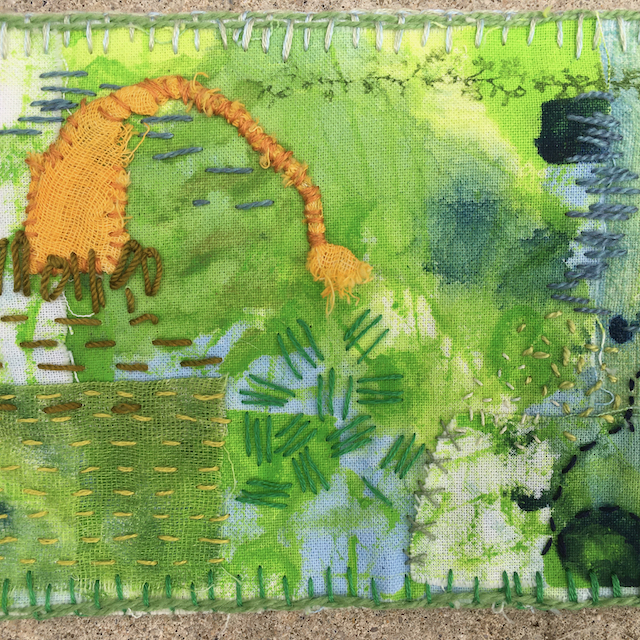
I gave myself the subject of my new garden (having moved to Dorset last year) for the larger paintings. Plants and trees had been left to run riot and grow through one another for nearly 10 years and patios and stepping stones had to be excavated to find their full sizes. Collage with mainly tissue paper seemed the best approach, allowing me to keep adding new shapes and suggested plant and flower formations as indeed the garden kept adding more and more growth as the year has progressed.
My collage papers are either painted or gelli printed.
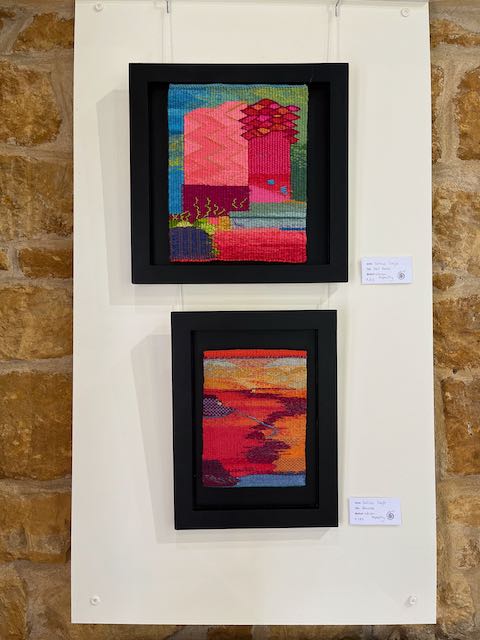
Tapestries are lengthy to complete and so some of the tapestries will have been seen before but Hot Patio has only recently been completed. Tesselations has been re-mounted into a better frame. Remote was made during the pandemic lockdowns and was exhibited in Northlight Gallery, Orkney.
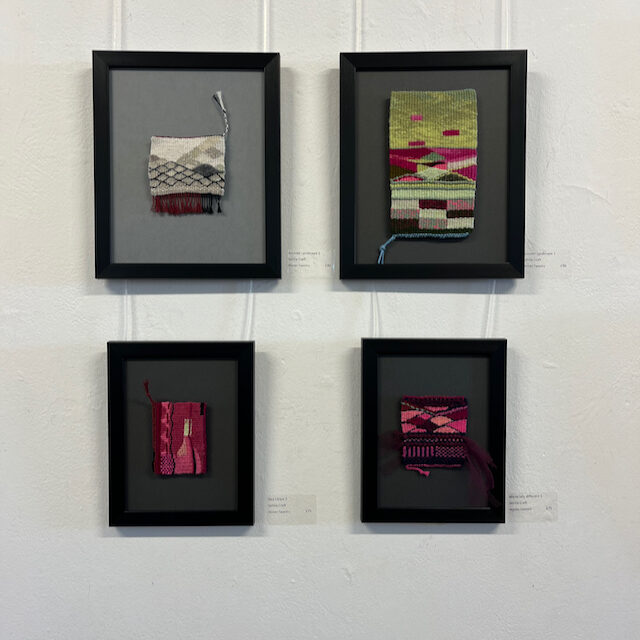
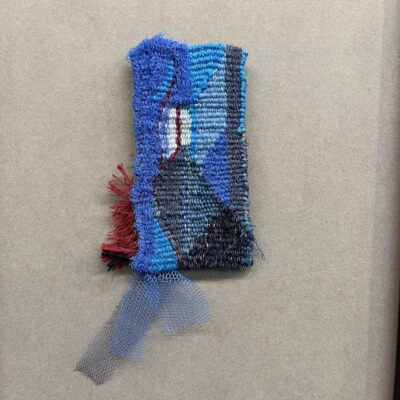
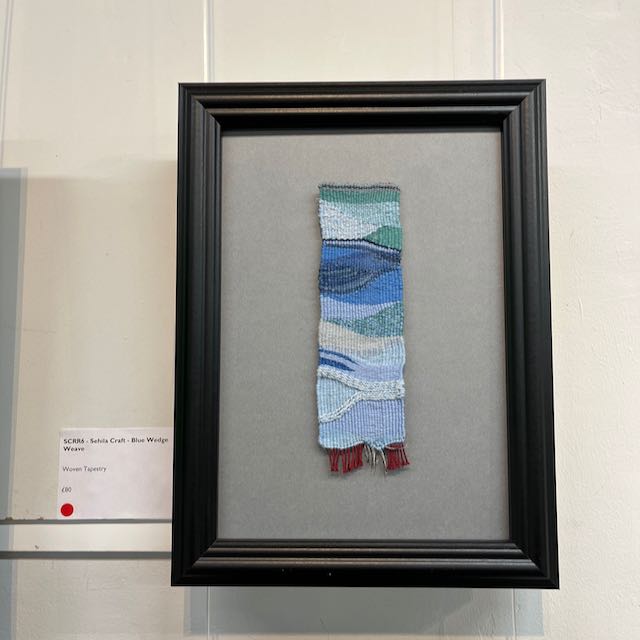
I’m enjoying small tapestries and they certainly went down well in the Oxmarket. I like the limited palette of this one and the obstructed view created by the red stripe.
I’m delighted to be exhibiting (sadly for the last time) with Artel Contemporary Art at the Oxmarket in Chichester. This year I am showing tapestries and I am excited to have sold four tapestries already.
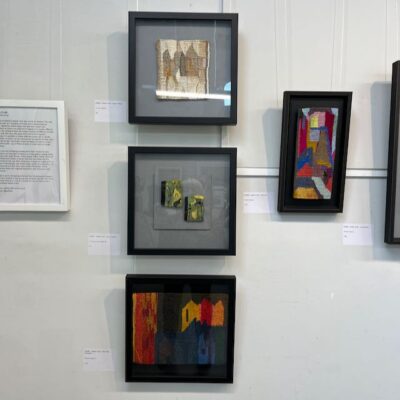
Paper Village (top)
Jane’s Garden (middle)
After Ben Nicholson (Bottom)Red StripeBlue Wedge Weave
My move to Dorset means that I cannot continue with Artel as it is a Chichester based group of artists and I am now in West Dorset. I shall miss the support and companionship of Artel but I hope to find art groups in Dorset and Somerset.
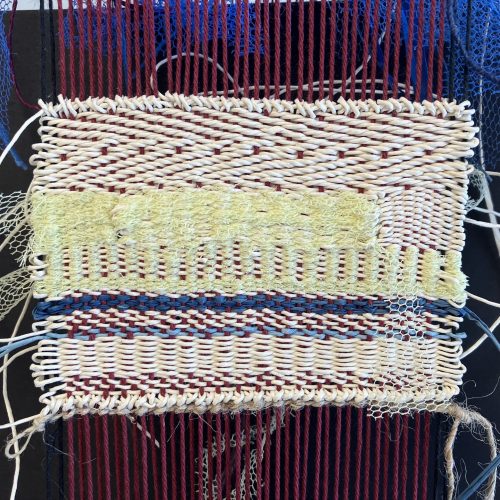
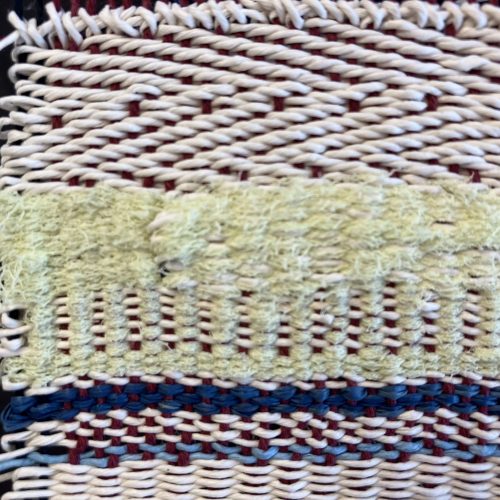
Now that the Artel Exhibition has finished I can return to my explorations of different materials to weave with – here I am using paper cord with yellow netting. It creates a rather stiff fabric with virtually no drape
This tapestry is called Stromness and is an interpretation of a gel-print that I made after my visit to Orkney. It was woven sideways, mainly because of the number of otherwise vertical lines, which are not helpful in tapestry weaving. There is plenty of warp left on the loom for another tapestry so it will remain on the loom for a little longer. There is a high level of blending of colours, achieved by combining several different, but related colours in the weft bundle (the yarn that goes side to side). I used my Schacht loom for this piece
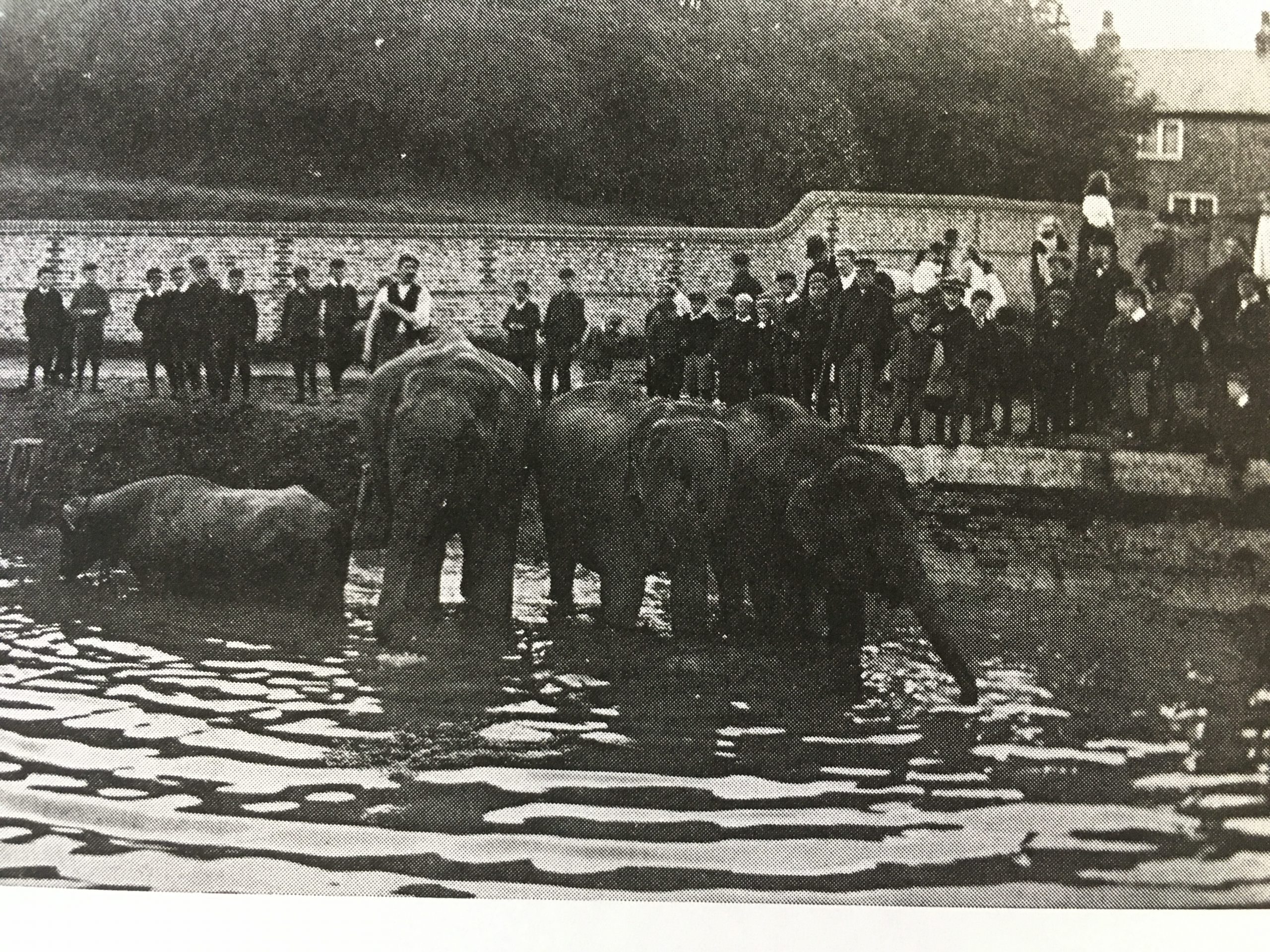
Members of Artel joined with the Chichester Canal Trust to celebrate 200 years of the canal. We viewed their archives and took walks and boat trips on the canal to gather information and then produced our own responses to the canal.
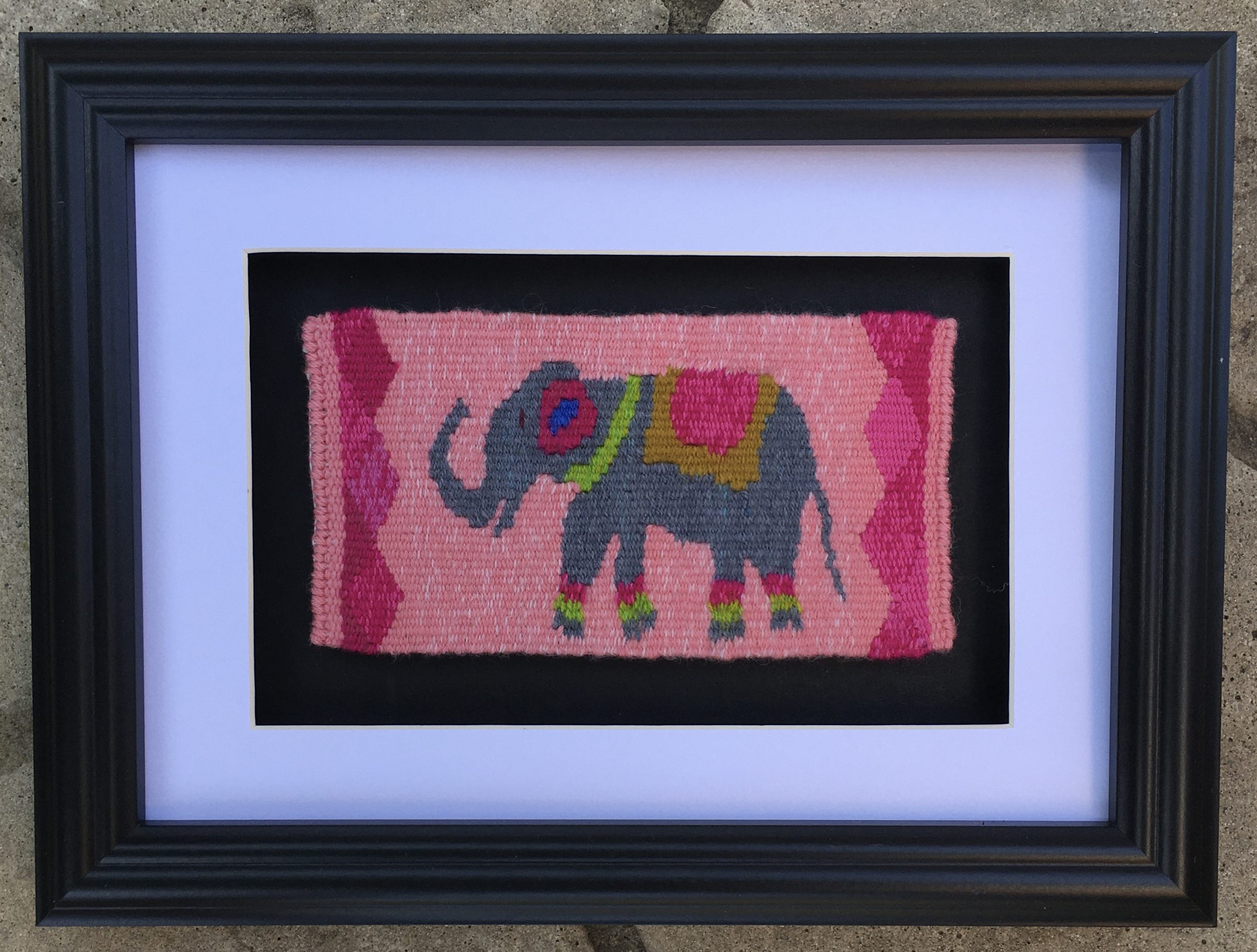
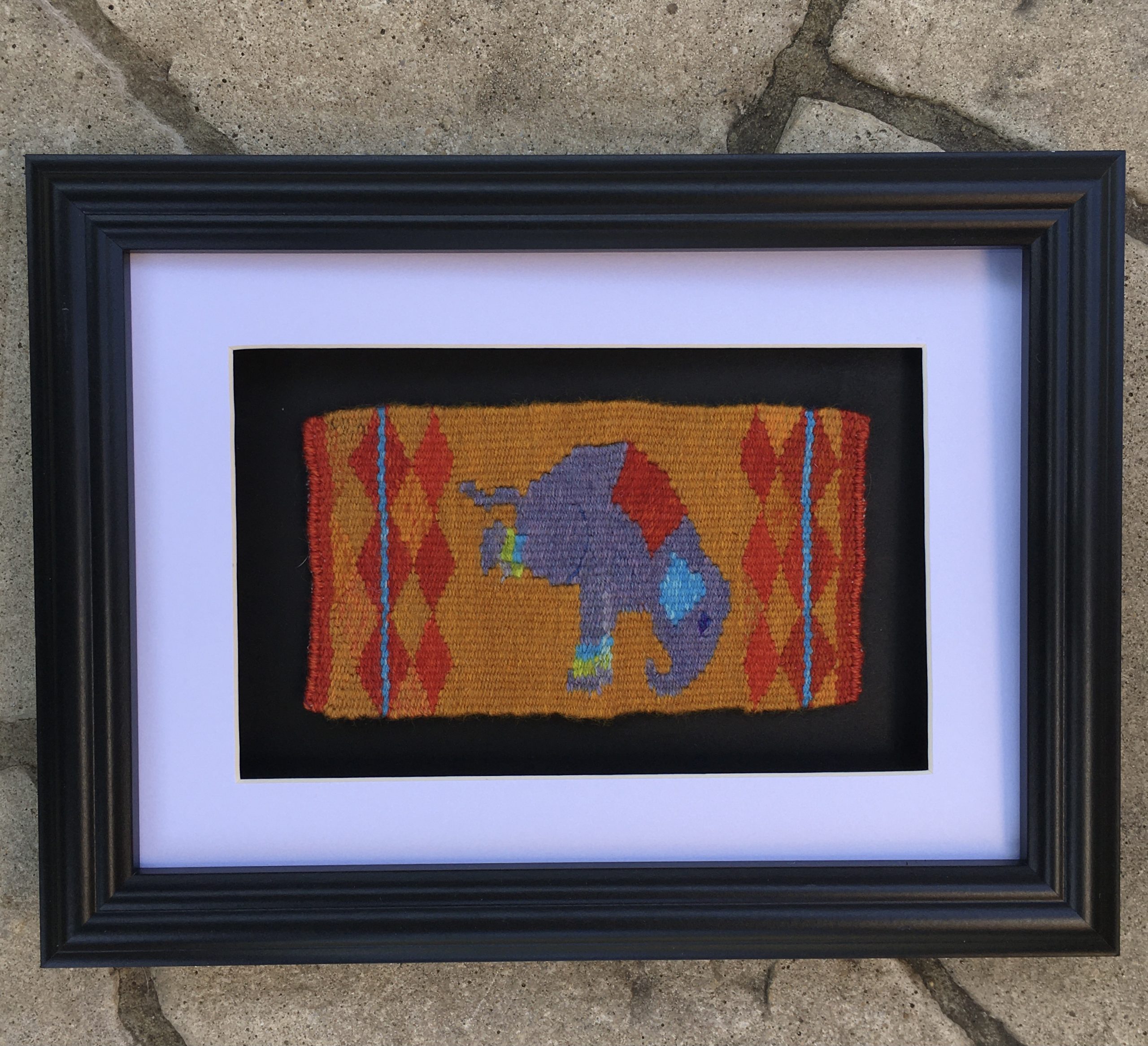
I was fascinated to see that elephants bathed in the canal in 1903 and I made two tapestried of how I imagined the circus elephants to be.
Circus elephants passing through Chichester in 1903, taking a bath in the canal basinNellie the ElephantBalancing Elephant
I also made embroideries of my walks on the canal
Hidden Gem Dawn 2Canal Journey (2) work in progressCanal PathCanal Journey 2 detailCanal Journey 1 detail
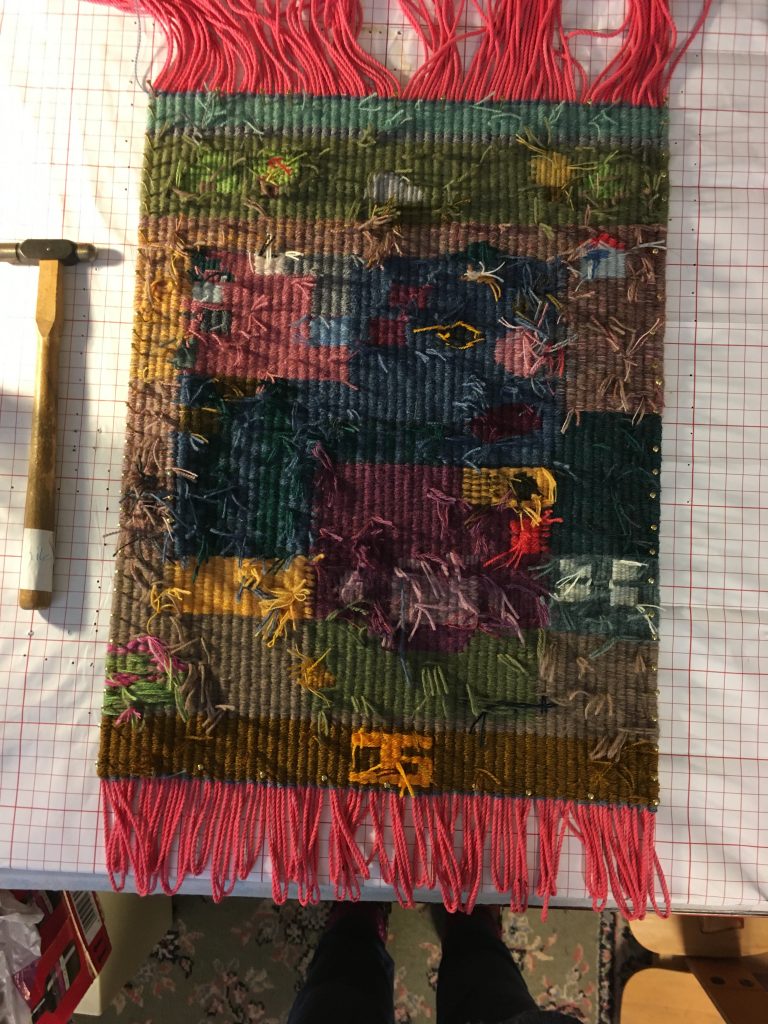
This is my latest and largest tapestry so far, woven on a pin loom. It shows a floor plan of the house I lived it from the age of 7 to 11 years old. It emphasises areas that were important to me such as the porch where I played two-ball (endlessly), the gramophone in the front room and the Wendy house in the garden. They were happy places and were woven in yellow (the happy colour). The area outside the back door also has a lot of yellow showing all the activity with children and dogs constantly in and out.
Devonshire Way – early stages
This shows the early stages of the tapestry, including the bottom selvedge with my weaver’s mark in orange. The warp is coral coloured, not quite the deep red I had hoped for when I was dyeing the warp. I find the natural warp colour difficult to ‘lose’ sometimes when I am preparing the work for showing and this is why I decided to dye it.
Devonshire Way – nearing completion
Tapestry creates a meditative state and I have been surprised at how some very obscure memories of my childhood home have come to mind, such as the fact that there was a green step-stool in the corner in the kitchen. Other details, like the position of the furniture in the back room (lounge) were more difficult to bring to mind, although I do remember sitting on the sofa under the slope of the stairs. It would have been called a settee in those days.
The brass-bound, black coffee table and the round, wicker dog basket were important parts of the lounge to me – whereas I have had to guess at the positions of the chairs, which were for adults. On the whole we children sat or lay on the floor. The TV had a V shaped aerial on top of the set, which sat in the corner of the room.
The hall had a very strongly patterned, green carpet, which continued up the stairs (which I loved to crawl down on my tummy).
I included the Wendy house in the back garden as I fell in love with this when my family viewed the house before moving in. I was so disappointed when we arrived on learning that the previous residents took the Wendy house with them. Also included in the tapestry are the fruit trees in the garden and the igloo that we built one very cold winter.
Completing a tapestry is always a pleasure, even thought a lot of work remains in order to prepare it for use.
Devonshire Way – back of the completed tapestry
Preparing to ‘block’ the tapestry
The back of the tapestry needs the ends and spent bobbins trimming off and then the work is pinned out ready to ‘block’ the piece.
There’s something about the house that I was born in that draws me. Happy times I guess. Learning about the world was always enjoyable and I was keen to know learn the next thing. Even then I was drawing out little maps of the roads that I knew – the roads to school, the way to the library and the shops and then later on, my route to the bigger school, which I wasn’t allowed to do on my own. It requiring crossing Brigstock Road with all its buses and vans. It seems amazing now, that I was allowed to walk to school on my own as an infant, crossing two minor roads. We lived in a Victorian semi, which originally had three bedrooms and then the back bedroom was converted to a bathroom and box room.
The House that I was Born in
As this tapestry progressed, I was interested in how my use of colours developed. I had an idea of a palette and had decided not to be driven by the aesthetic of the work, which would be my usual approach. Instead, colours took on a meaning and in particular, bright orange for no-go areas like the scullery, that we weren’t allowed into as children. The pale blue areas show where we lived routinely, and places like the front room were very vague to me, only used for visitors and for short periods of time and very cold, with Lino round the edge of the room.
The house I was born in
Another surprising thing for me was the realisation that, in my mind, I always see the plan of this first house with the back of the house at the bottom. Other houses I’ve lived in I see the other way around, the front of the house at the bottom. I guess that I didn’t have to enter this house – I was already in it. It’s where I was born.
The tapestry is small, but quite precious to me and is probably technically my best work so far. I am now starting work on a larger tapestry 33cm wide for my 7-11 house (we moved twice when I was a child). I am going to experiment with using sock wool (cheaper!) but I am wondering if it will be as resilient as the beautiful worsted yarns that I bought from Weaver’s Bazaar and my own dyed worsted yarns.
I have recently started the Foundation Diploma in Tapestry Weaving at West Dean College as I wanted to bring together my extensive research into colour, through painting and my many years of working with textiles, mostly through making and using yarn.
I have much to learn and am trying not to be too frustrated with this. Choosing the correct warp thickness and size of weft bundle (I didn’t even know that you could have a weft bundle!) has been quite challenging, but slowly I think I am getting there.
Sampler for borders
I am interested in how artists such as Kirsten Glasbrook use borders in their work and so I tried some ideas out here.
The image below also introduces the use of borders and a central motif with a variegated background to the motif. I was pleased with the colour scheme but I found that the ‘sett’ of the warp was too close for the thickness of the warp. This resulted in a rather congested tapestry that didn’t lie entirely flat. I’m still learning.
Border and bird tapestryIcon image
This small tapestry is an interpretation of my drawing of a radiator cover in Stansted House. I wanted to try out icon colours, but also to practise graduating the colour of both background and image from dark at the bottom to light at the top.
This is the first of a series of tapestries where the source material is one of my paintings. I am taking fragments of the original (unfinished) painting and interpreting them into tapestry weavings. They are approximately 10cm wide. This first fragment is made on a moderately thick warp (15s) with 2.5 ends to the centimetre. The bottom part is a bit ‘clunky’ but as my hatching improved the imagery improved towards the top. The colours worked for me.