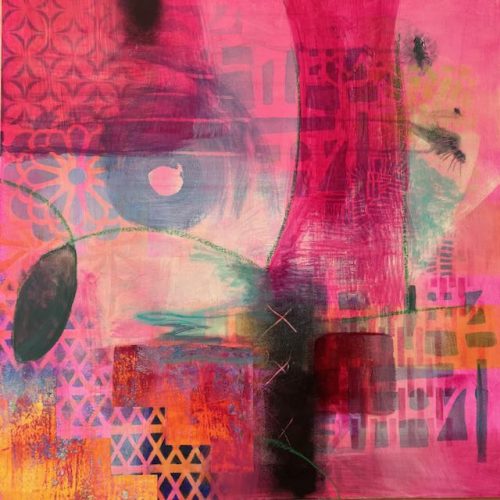
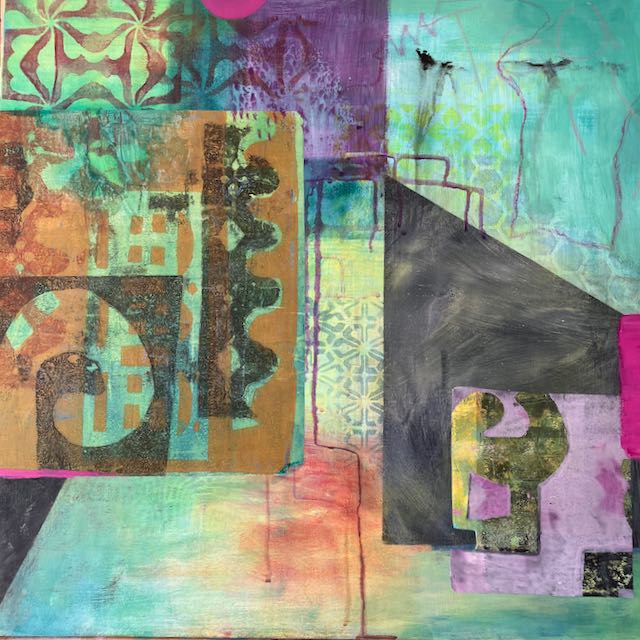
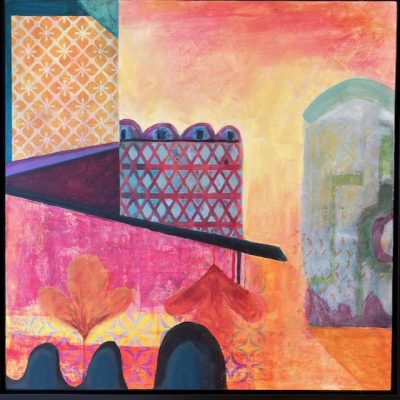
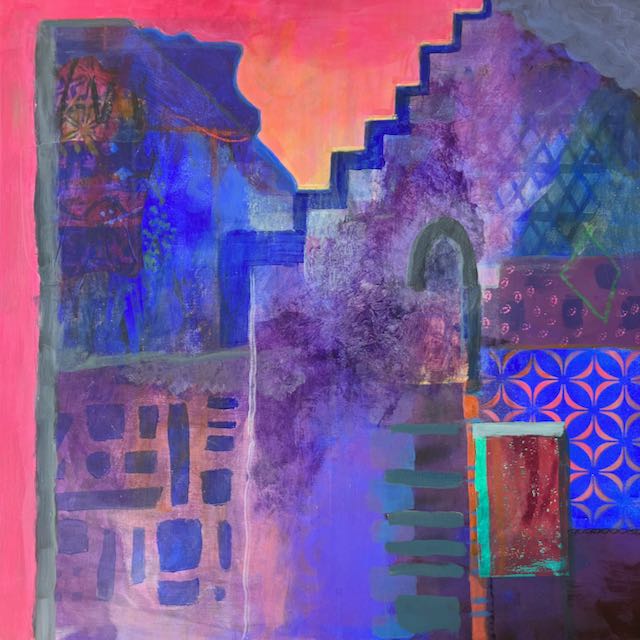
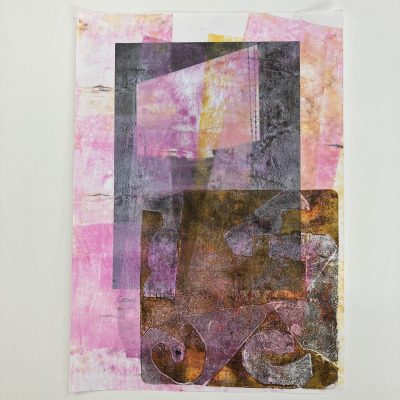
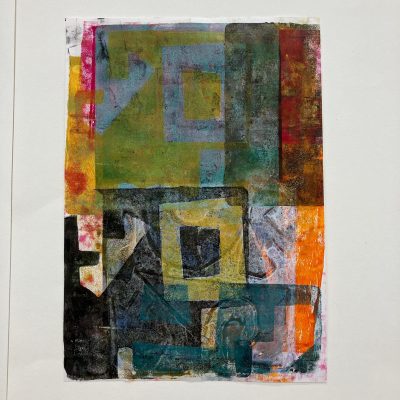
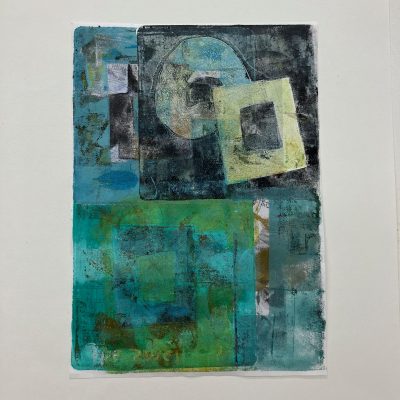
Sehila’s paintings are constructed layer by layer, often including her own collaged Gelli prints. By using transparent and translucent paints and glazes, earlier layers remain visible whilst being altered by the new colour. This invites the viewer to consider which layer came first.
Sadly, Sehila’s dog Treacle died during the making of three of the paintings and these paintings are dedicated to Treacle. Sehila has included imagery referring to her eyes and tears within these paintings, as she often struggled to see through her own tears whilst painting.
Tears for Treacle – Pink
What Lies BeneathTears for Treacle – Green
What Lies BeneathPattern
Mixed Media on board 50 x 50cmTears for Treacle – Blue
What Lies Beneath
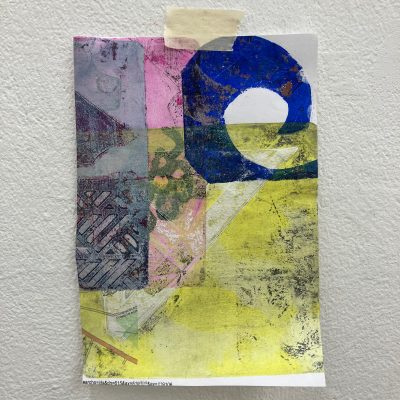
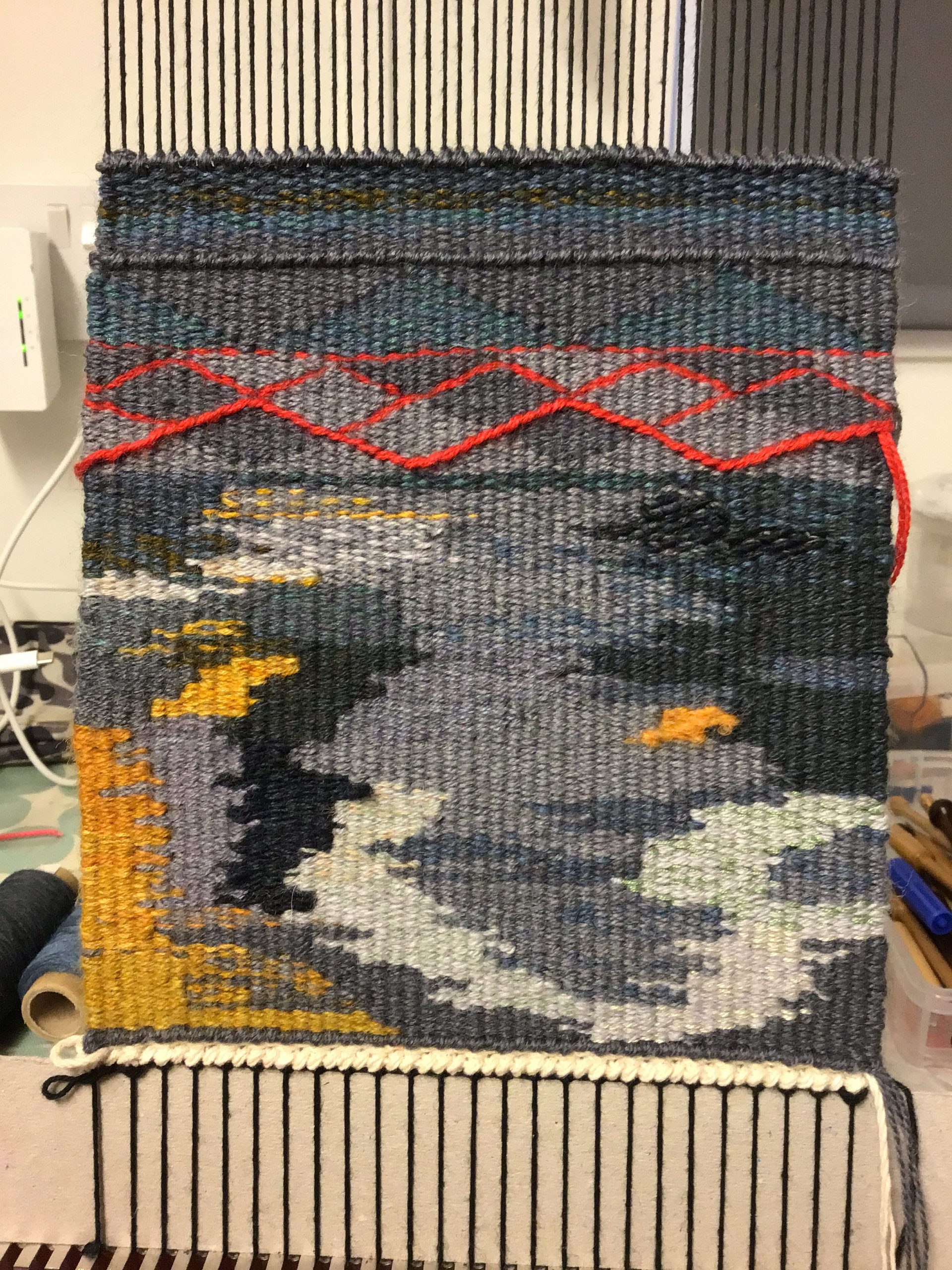
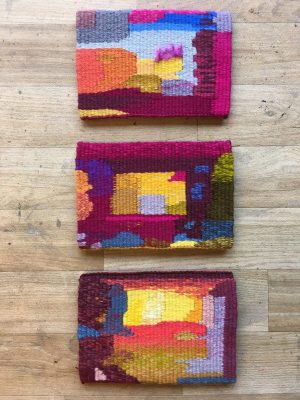
This tapestry is called Stromness and is an interpretation of a gel-print that I made after my visit to Orkney. It was woven sideways, mainly because of the number of otherwise vertical lines, which are not helpful in tapestry weaving. There is plenty of warp left on the loom for another tapestry so it will remain on the loom for a little longer. There is a high level of blending of colours, achieved by combining several different, but related colours in the weft bundle (the yarn that goes side to side). I used my Schacht loom for this piece
I’m getting excited about my upcoming 5 day residency at Emily Ball at Seawhites, in Partridge Green. I am planning to revisit places on Star Road Industrial Estate, looking for shapes and spaces to focus on. I’ve packed my small Gelli plate, as I will inevitably be making some Gelli prints as part of my preparation for some painted studies. I want to look for possibilities rather than focus on getting finished paintings. Pattern and colour will feature, as always. I can’t wait!
12 September
The residency was no disappointment and was a worthwhile way to develop my wok further. I shared the space not only with Emily Ball but with Karen Stamper, Geoff Parham, Jax Arnold, JoJo Perkins and Alison Carlier. Having the dedicated space and dedicated time leaves no hiding place – you have to get on with the work with no distraction.
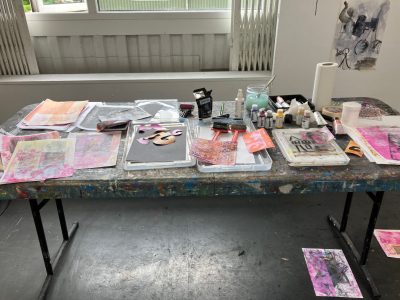
Gelli printing workstation
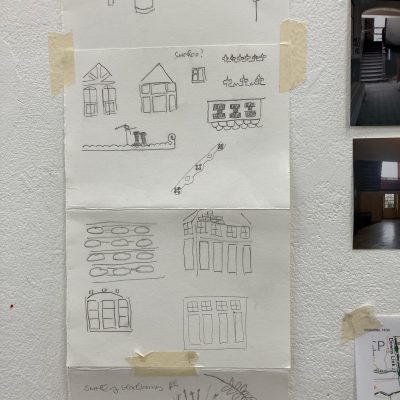
I started my week with a walk to the village of Partridge Green, where I used to live and made sketches of shapes that interested me. These were mostly architectural and in the event – narrowed down to rooflines and windows.
Shapes drawn in the village
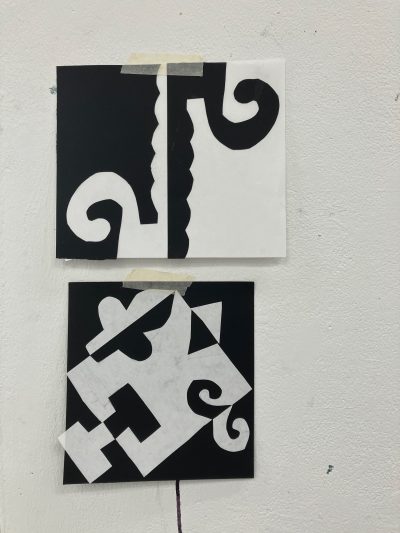
A notan study was my first move back at the studio and this was a powerful reference during the week and is on my wall in my studio back at home.
Notan study based on architectural features
Cutting stencils to work from is time consuming and for me, difficult as I find that the blade slips on the acetate sheet.
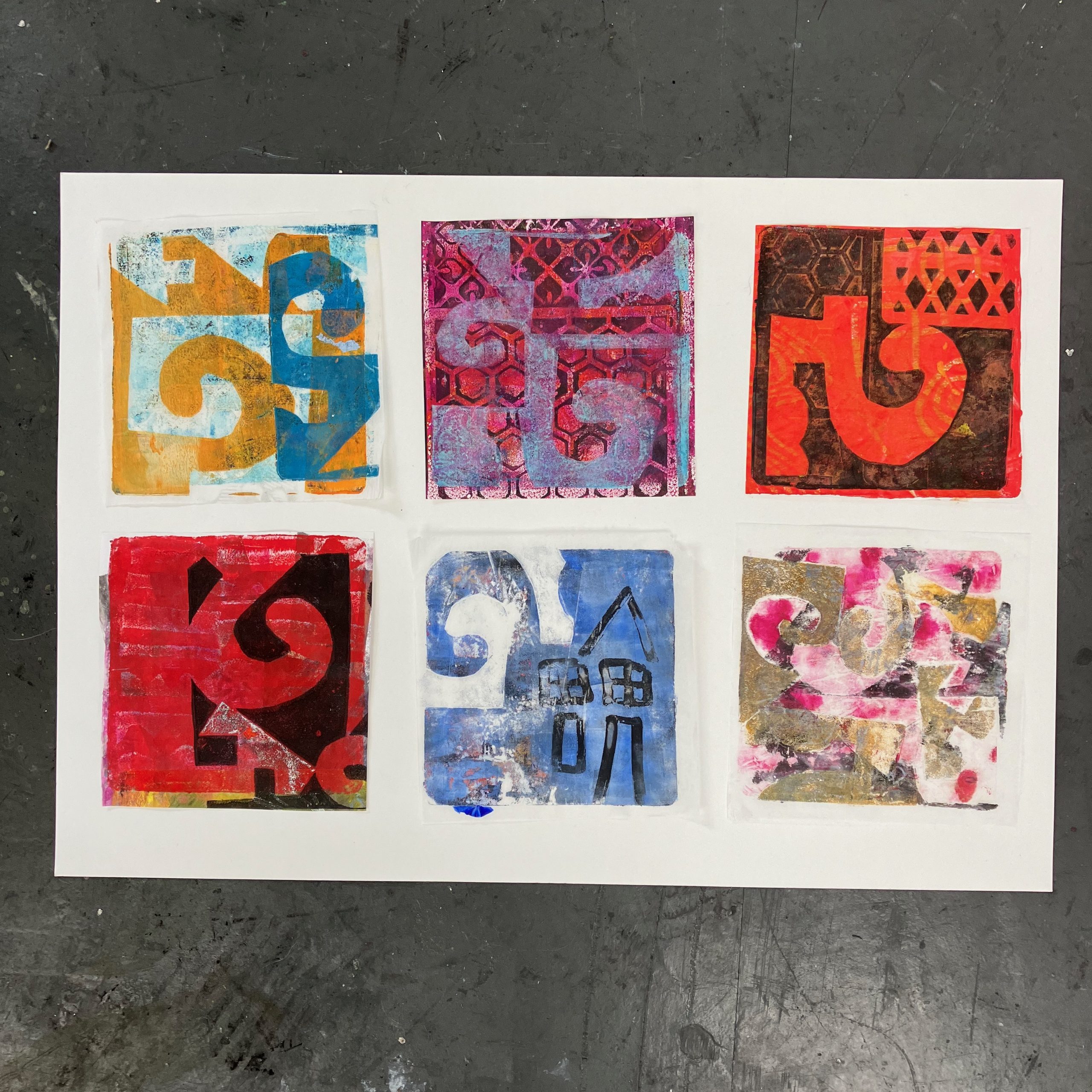
Early prints – not many layers
I decided to restrict the number of papers that I worked with to see what multiple layers would achieve. This worked well for me mostly.
UntitledUntitledUntitled
I started the week saying that I was not looking for any finished work and that gelli prints would be for collage purposes, I listened to the other artists (and the prints themselves) and realised that the printed papers had their own qualities and that a series of motifs were enough to work with.
Why does the Gelli plate look better than the print?!Untitled
The residency was also an opportunity to experiment and learn more about Gelli printing. I tried writing with Posca pens onto the plate and transferring written and drawn images onto the plate using oil pastels. I also learned a lot about temperature and keeping the ink on the plate active – or how to exploit inks that had dried onto the plate. The biggest learning point for me was to keep the roller(s) and stencils clean. I tend to do this in my own studio – using a bowl of water to put the used stencils in. However, I didn’t do this and ultimately I found that dried on paint on the rollers would absorb the fresh paint I was trying to put onto the plate. I soaked the rollers when I got home and was able to peel off the paint like cylindrical overcoats, leaving a clean roller underneath.
Dropping the rollers into water after each use is keeping them clean and workable, but is a pain to get them dry after each use – lots of wet towels needed to achieve it. Ditto the stencils especially if I am creating a series of repeated patterns.
Members of Artel joined with the Chichester Canal Trust to celebrate 200 years of the canal. We viewed their archives and took walks and boat trips on the canal to gather information and then produced our own responses to the canal.
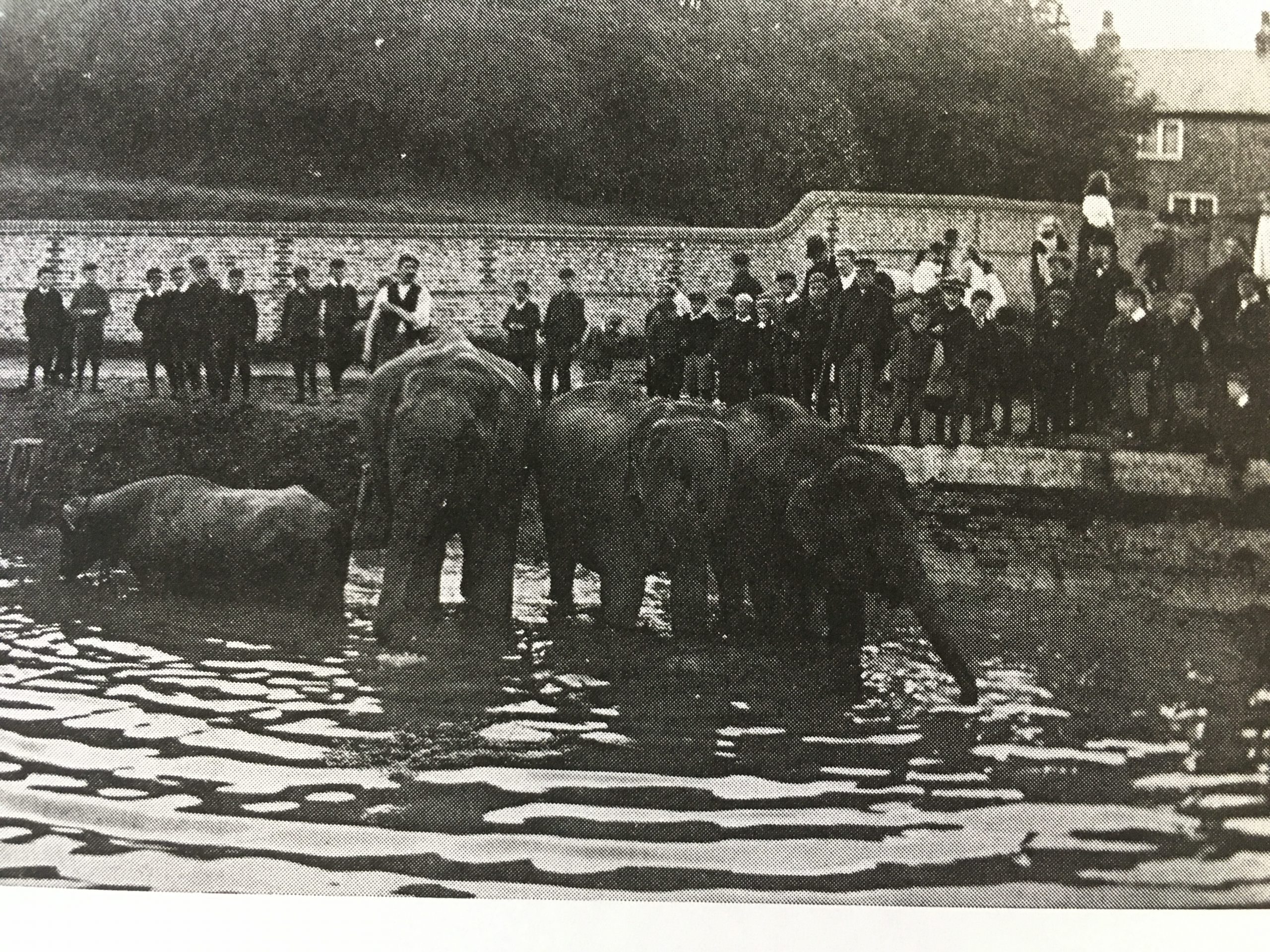
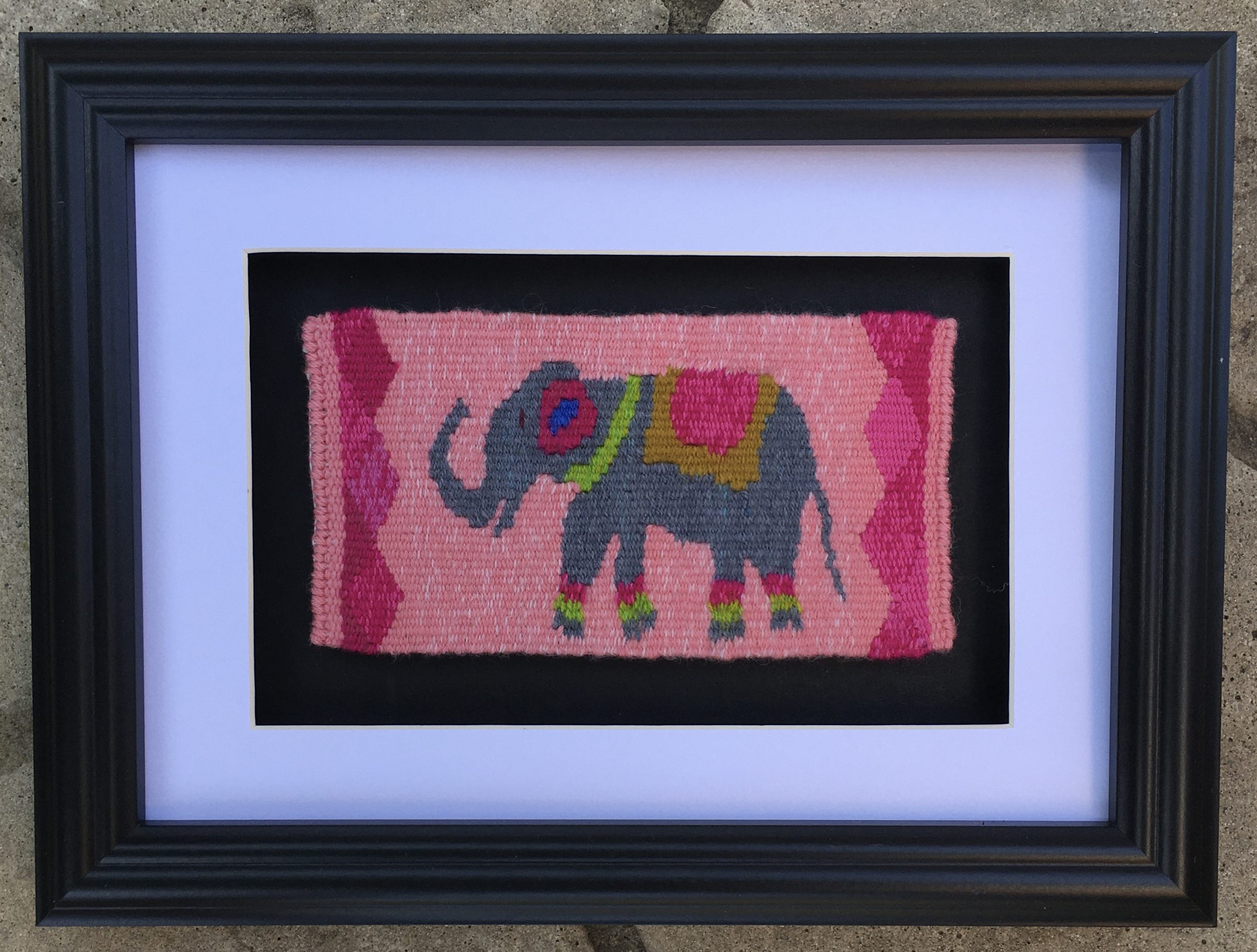
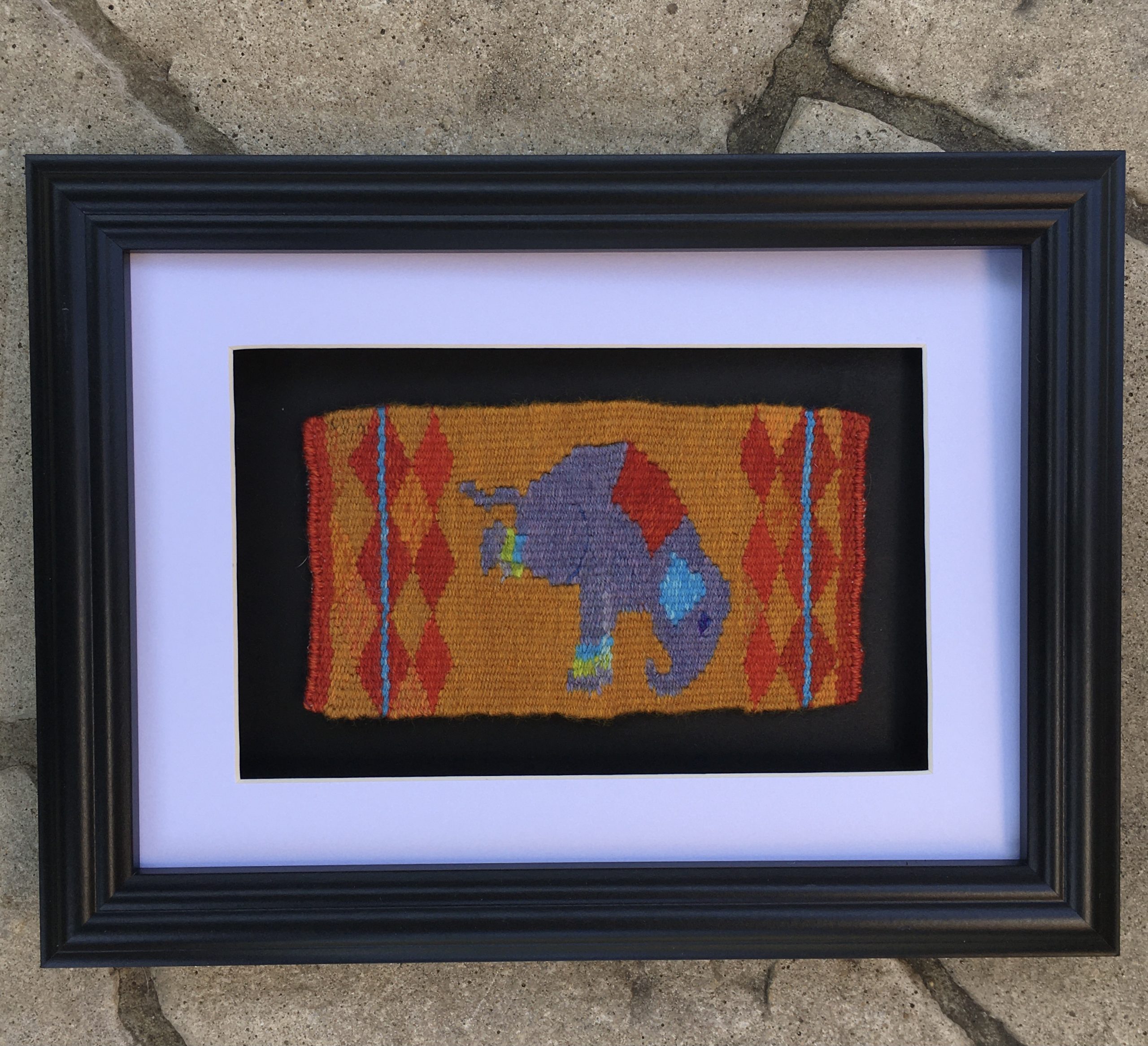
I was fascinated to see that elephants bathed in the canal in 1903 and I made two tapestried of how I imagined the circus elephants to be.
Circus elephants passing through Chichester in 1903, taking a bath in the canal basinNellie the ElephantBalancing Elephant
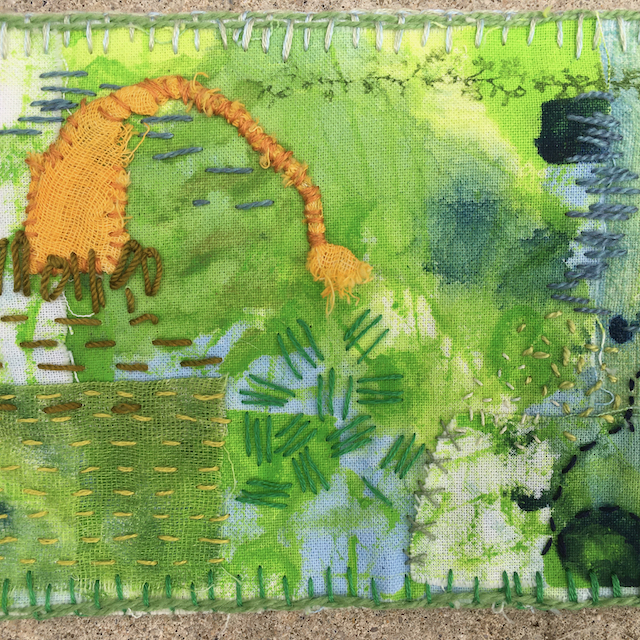
I also made embroideries of my walks on the canal
Hidden Gem Dawn 2Canal Journey (2) work in progressCanal PathCanal Journey 2 detailCanal Journey 1 detail
As a member of Artel Contemporary Art, I and other members of the group, am researching and preparing work, which celebrates the canal’s 200 years, for our exhibition in June 2022 at the Oxmarket Chichester.
Finding the right ‘angle’ for any themed exhibition takes me quite a while and often several false starts before I find something that I can work with. Two things have emerged from my research, which has included a boat trip on the canal, walks on the towpath, drawing sessions alongside the canal and special access to the Canal Heritage archives (for which we are very grateful).
Circus elephants passing through Chichester in 1903, taking a bath in the canal basin
I was fascinated by finding in the archives, a photo from 1903, of circus elephants (and a cow!) bathing in the canal as they passed through Chichester. I couldn’t resist creating my own versions in tapestry weaving, of what these (poor) elephants might have looked like in the ring. The canal must have been a welcome reminder for them of what life should be for an elephant.
Nellie the ElephantBalancing Elephant
A second elephant performing a trick is being ‘finished’ to go alongside Nelly.
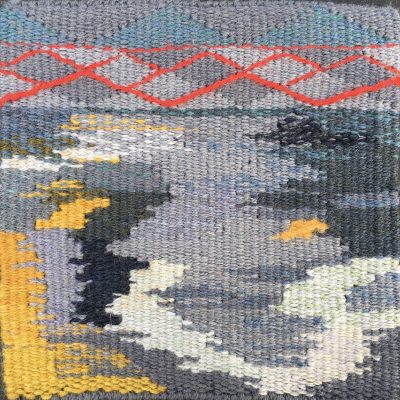
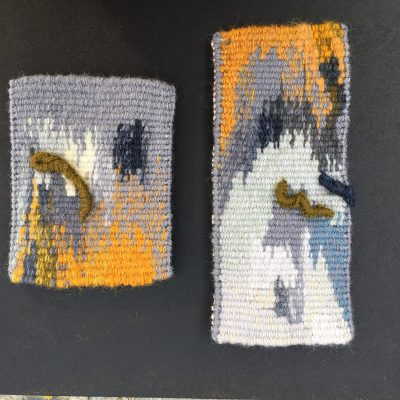
I thought about what the bottom of the canal might look like and how it ultimately meets the sea beyond Saltern’s Lock. I made some studies of how water behaves on paper, using black and yellow inks. Using these as a guide, I made tapestry weaving samples
Canal studies – samplers
The final tapestry in this series shows red diagonals to reference the structure of Poyntz Bridge
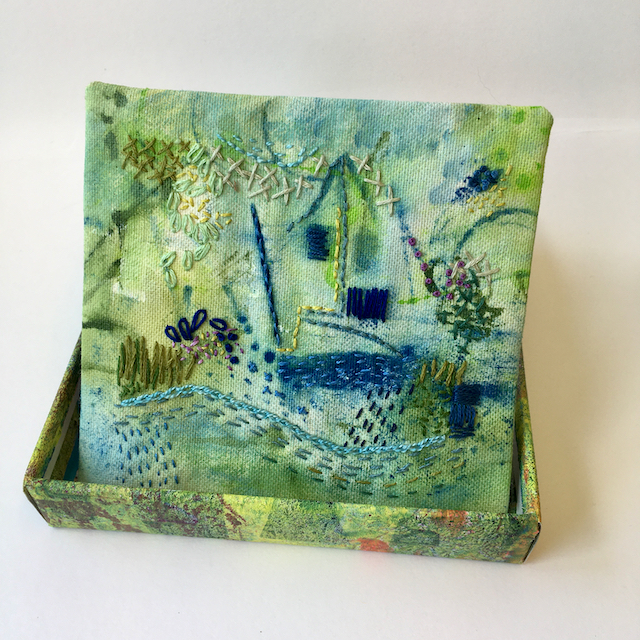
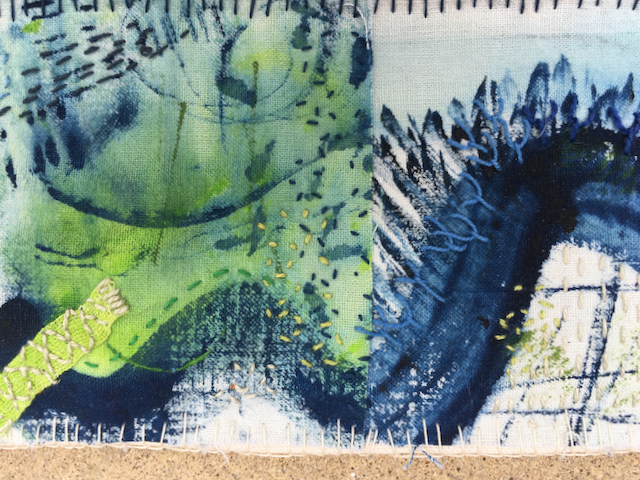
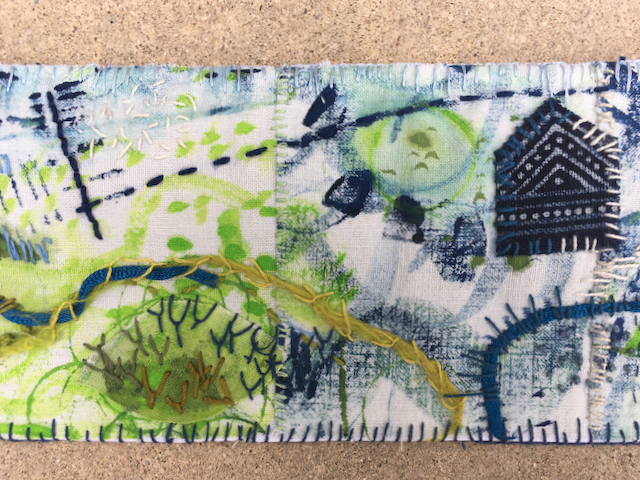
In addition to tapestries, I have made three hand embroideries in which I make a stitched response to the walks, the photographs and the drawings which have made up my research into the canal as it is today., including yellow diggers lined up alongside the canal. Two of the three embroideries in this series are now complete. The embroideries are 10cm deep and 70cm wide, reflecting the feel of travelling along the canal on the towpath or by boat where it is navigable. I have taken imagery and shapes within the canal environment without being too literal. In the embroidery (not yet shown) which represents the canal basin, I have included a small pink elephant (well you wouldn’t expect to see an elephant in the canal would you? I must be drunk! Hence a pink elephant*) I have shrouded the elephant and my representation of the watching boys behind a thin gauze to represent looking through the mists of time rather than what can be seen today.
The work on this topic continues.
Canal Journey (2) work in progressCanal Journey (2) detailHidden Gem DuskHidden Gem Dusk
*This is also a timely reference as the first recorded mention of pink (and green) elephants was in 1896 in Fables of our time by Henry Wallace Phillips.
Phillips, Henry Wallace (April 30, 1896). “The Man and the Serpent”. Life. 27 (696): 343.
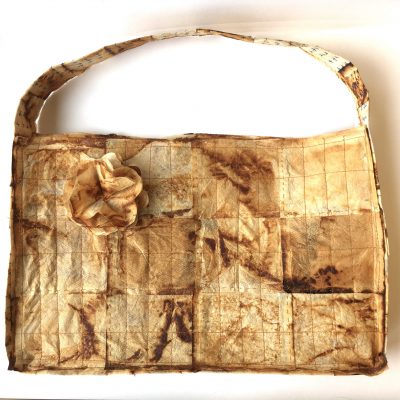
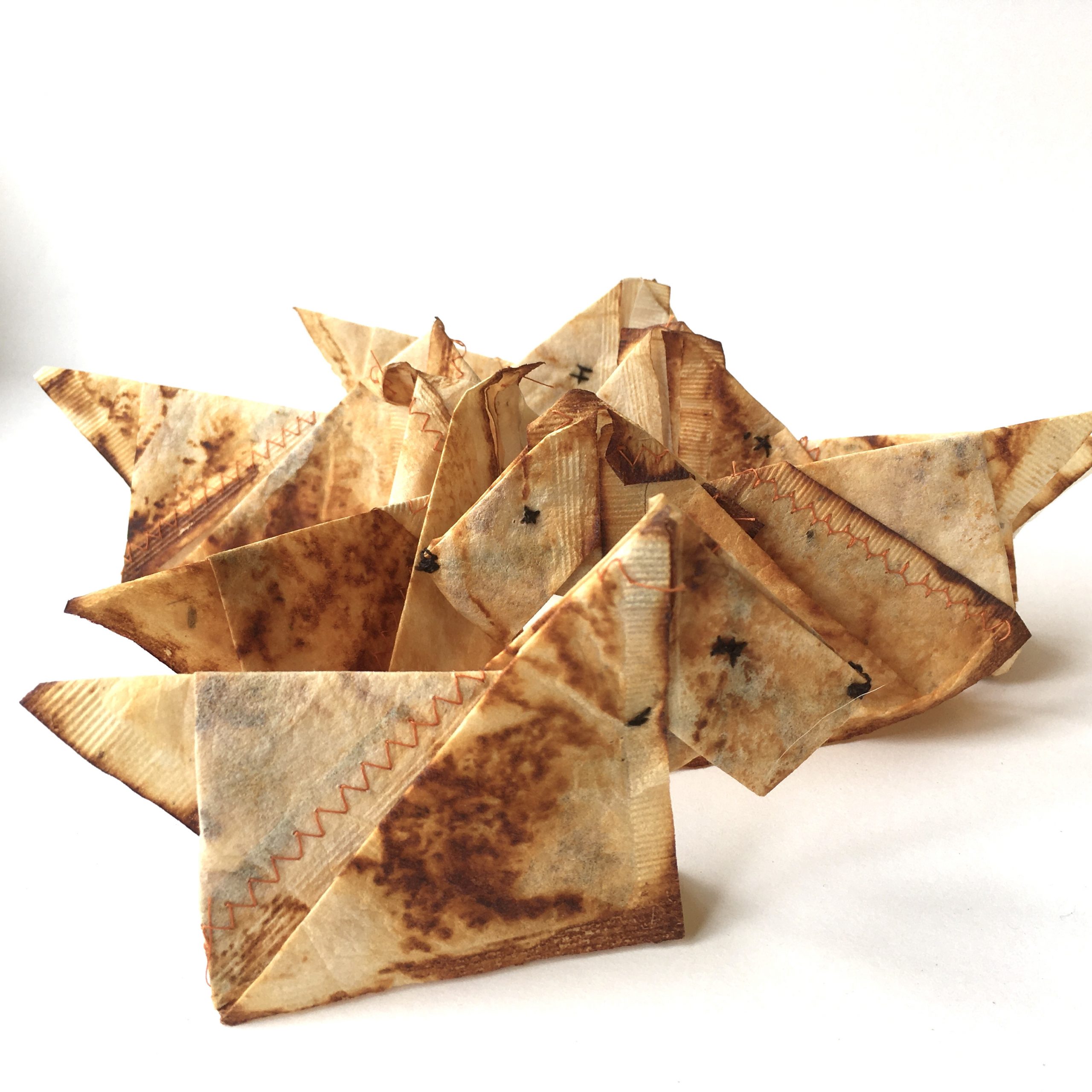
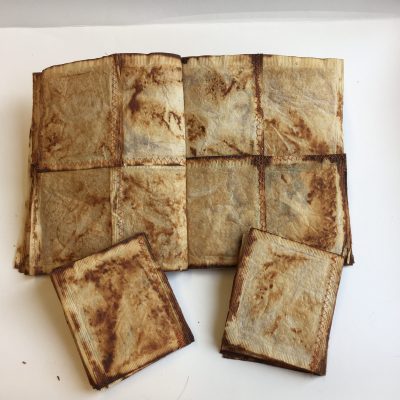
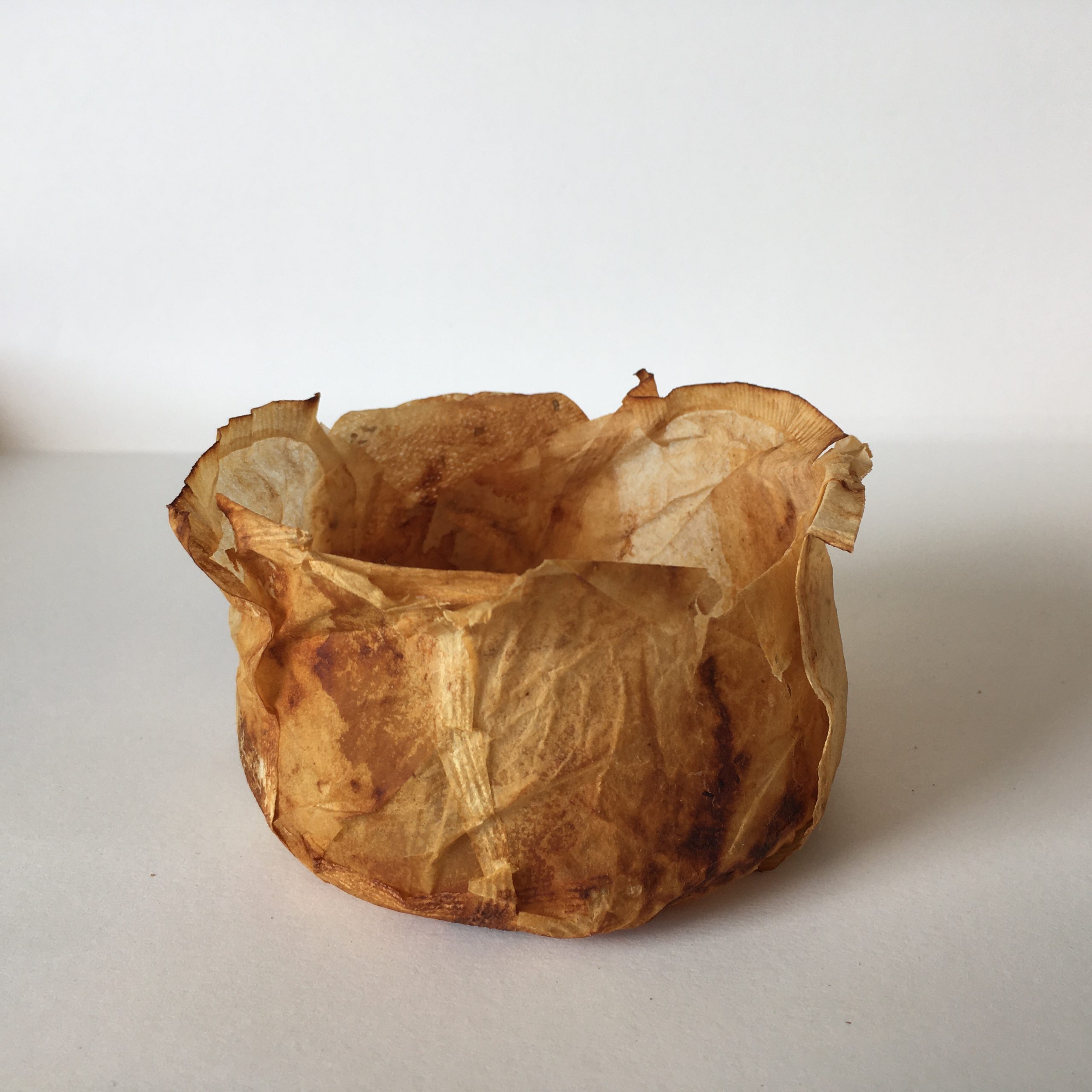
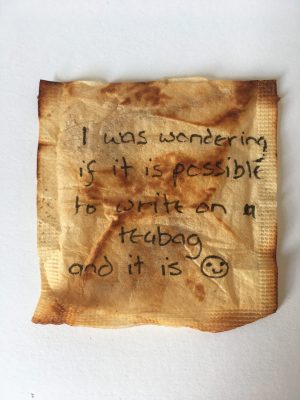
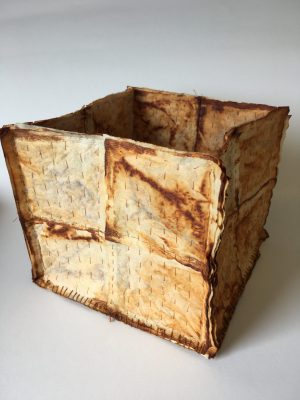
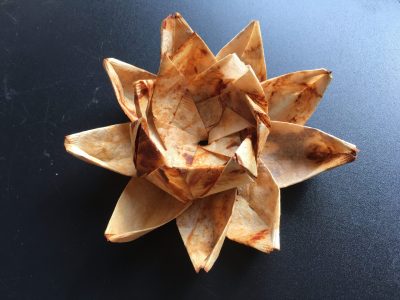
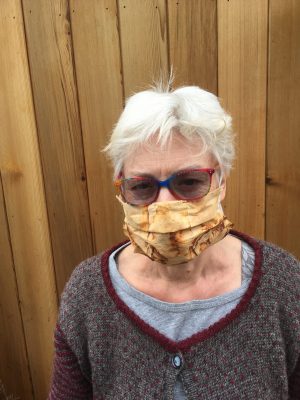
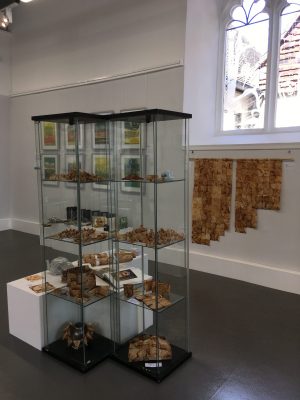
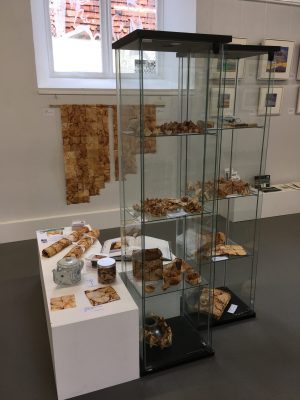
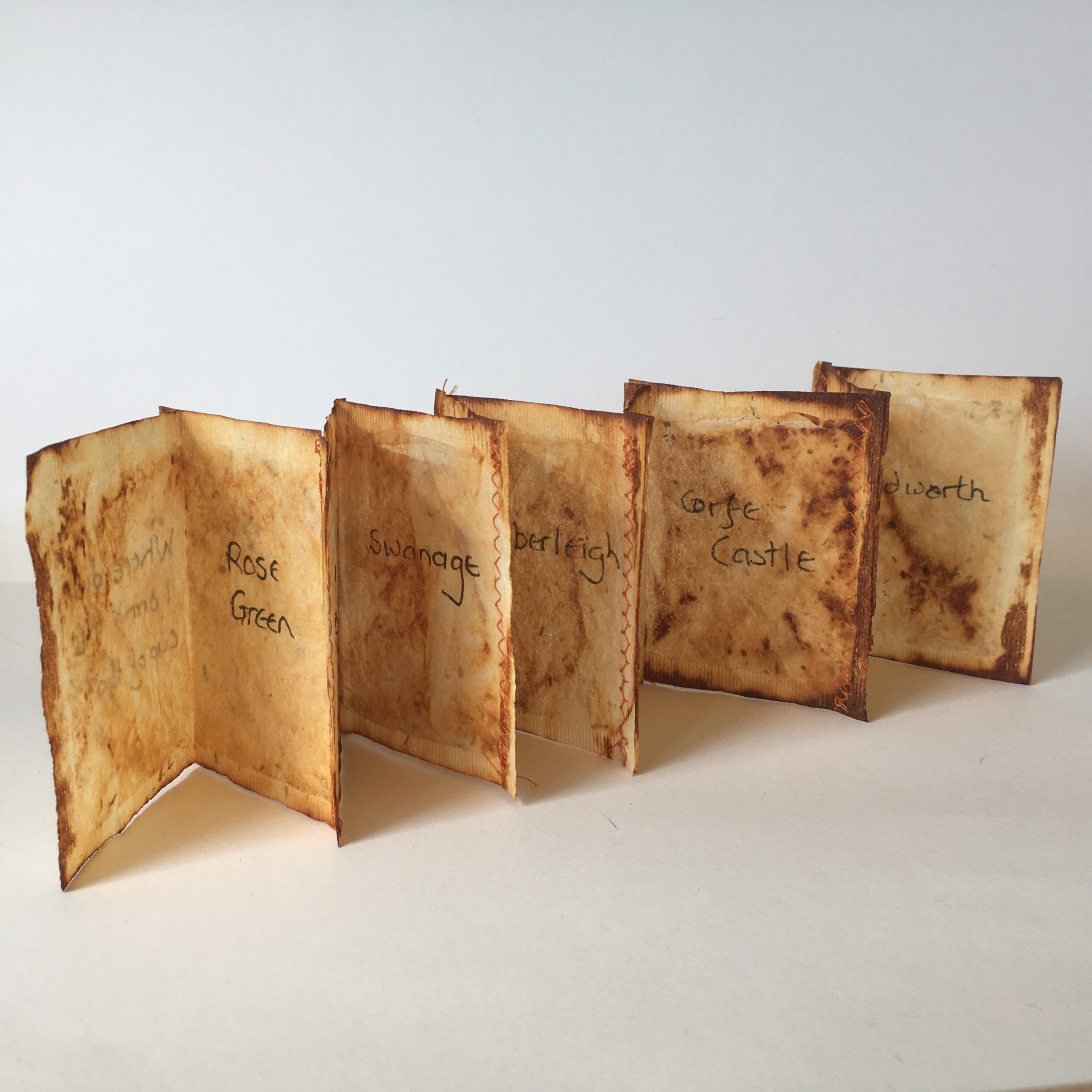
Teabag Display Oxmarket ChichesterTea BagTeabag BowlI was wondering if it is possible to write on a teabag – and it isTea CaddyLotus FlowerFirst Lockdown
“In Ireland, you go to someone’s house, and she asks you if you want a cup of tea. You say no, thank you, you’re really just fine. She asks if you’re sure. You say of course you’re sure, really, you don’t need a thing. Except they pronounce it ting. You don’t need a ting. Well, she says then, I was going to get myself some anyway, so it would be no trouble. Ah, you say, well, if you were going to get yourself some, I wouldn’t mind a spot of tea, at that, so long as it’s no trouble and I can give you a hand in the kitchen. Then you go through the whole thing all over again until you both end up in the kitchen drinking tea and chatting.
In America, someone asks you if you want a cup of tea, you say no, and then you don’t get any damned tea. I liked the Irish way better.” ― C.E. Murphy, Urban Shaman
Tea is such an integral part of life – certainly British life, possibly more so for the older generation. When a visitor arrives at our houses we immediately offer them a cup of tea. Making tea is suggested as a suitable response to receiving bad news. It gives the recipient of the news something practical to do, somewhere to put their grief, or shock – for the moment anyway.
“If you are cold, tea will warm you; if you are too heated, it will cool you; If you are depressed, it will cheer you; If you are excited, it will calm you.” -William Ewart Gladstone
Tea has invaded our language too – we talk about someone or something being just “my cup of tea”, something we feel comfortable with and we enjoy. Jack Buchanan explains our love of tea so well in his song EVERYTHING STOPS FOR TEA, which was featured in Buchanan’s 1935 comedy film, “Come Out Of The Pantry” (Goodhart / Hoffman / Sigler) Jack Buchanan
I couldn’t give quotations about tea without a mention of Billy Connolly’s “Never trust a man who, when left alone in a room with a tea cozy, doesn’t try it on. ”
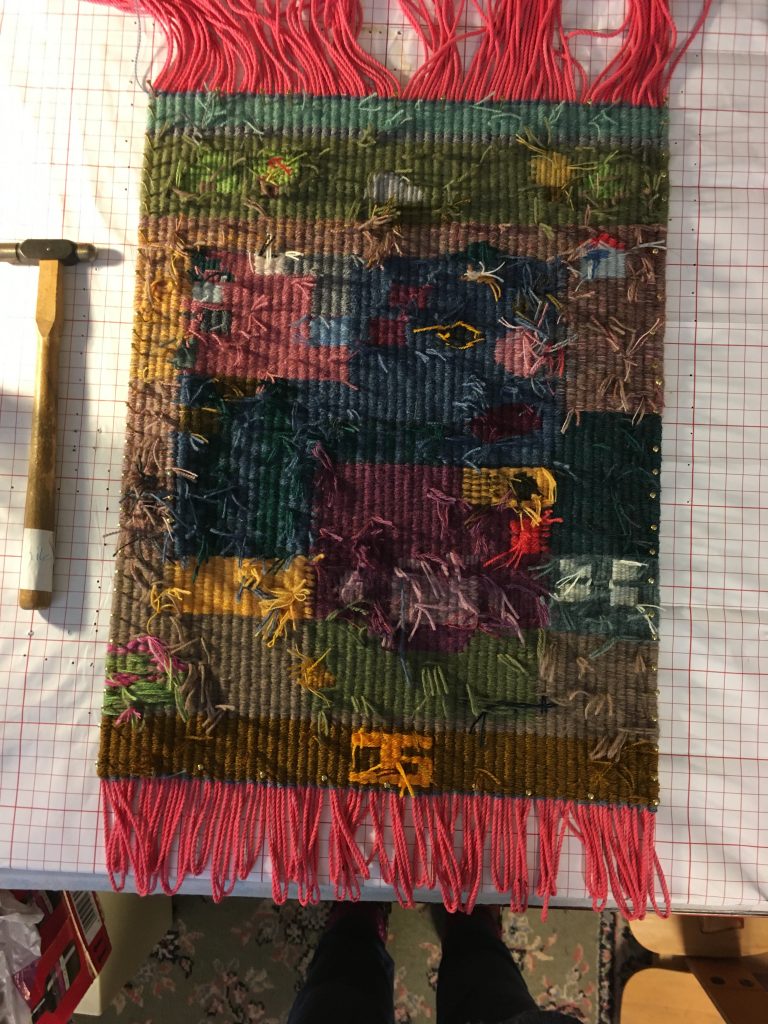
This is my latest and largest tapestry so far, woven on a pin loom. It shows a floor plan of the house I lived it from the age of 7 to 11 years old. It emphasises areas that were important to me such as the porch where I played two-ball (endlessly), the gramophone in the front room and the Wendy house in the garden. They were happy places and were woven in yellow (the happy colour). The area outside the back door also has a lot of yellow showing all the activity with children and dogs constantly in and out.
Devonshire Way – early stages
This shows the early stages of the tapestry, including the bottom selvedge with my weaver’s mark in orange. The warp is coral coloured, not quite the deep red I had hoped for when I was dyeing the warp. I find the natural warp colour difficult to ‘lose’ sometimes when I am preparing the work for showing and this is why I decided to dye it.
Devonshire Way – nearing completion
Tapestry creates a meditative state and I have been surprised at how some very obscure memories of my childhood home have come to mind, such as the fact that there was a green step-stool in the corner in the kitchen. Other details, like the position of the furniture in the back room (lounge) were more difficult to bring to mind, although I do remember sitting on the sofa under the slope of the stairs. It would have been called a settee in those days.
The brass-bound, black coffee table and the round, wicker dog basket were important parts of the lounge to me – whereas I have had to guess at the positions of the chairs, which were for adults. On the whole we children sat or lay on the floor. The TV had a V shaped aerial on top of the set, which sat in the corner of the room.
The hall had a very strongly patterned, green carpet, which continued up the stairs (which I loved to crawl down on my tummy).
I included the Wendy house in the back garden as I fell in love with this when my family viewed the house before moving in. I was so disappointed when we arrived on learning that the previous residents took the Wendy house with them. Also included in the tapestry are the fruit trees in the garden and the igloo that we built one very cold winter.
Completing a tapestry is always a pleasure, even thought a lot of work remains in order to prepare it for use.
Devonshire Way – back of the completed tapestry
Preparing to ‘block’ the tapestry
The back of the tapestry needs the ends and spent bobbins trimming off and then the work is pinned out ready to ‘block’ the piece.